Pelvic Congestion Syndrome
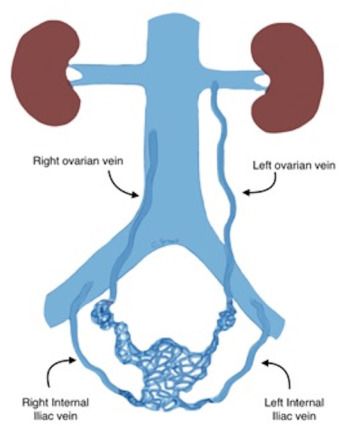
Pelvic congestion syndrome often co-occurs with May-Thurner and Nutcracker. Pelvic congestion syndrome has been thought to affect predominantly women who have been pregnant, but it can also be found in those who have never been. In females, pelvic congestion involves dilation of the veins in the pelvis, which can include the gonadal (ovarian), gluteal, or periuterine veins. Dilation of the left ovarian vein is a common culprit, as the vein extends from the plexus near the left ovary and fallopian tube up to the left renal vein. These veins are generally not visible from the outside, which can make it less obvious in terms of getting diagnosed.
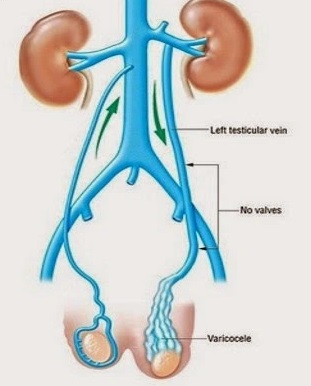
For males, varicoceles – enlarged veins in the scrotum – or varicose veins in the testicles can result. The left testicular (or gonadal) vein drains from the testis up to the left renal vein. Individuals may experience feelings of heaviness, and pelvic and abdominal fullness.
In Nutcracker Syndrome, compression of the left renal vein can lead to dilation of the left ovarian or gonadal vein, because blood is not flowing properly through the renal vein. In May-Thurner Syndrome, the left common iliac vein is compressed. The left internal iliac vein joins with the uterine vein; the pooling of blood can thus trigger pelvic congestion.
Some medical professionals prescribe synthetic progesterone as a treatment for pelvic congestion syndrome. Especially if a compression is present, however, this alone may not necessarily be sufficient because it does not address the root cause.
One of the common treatments for pelvic congestion is ovarian or gonadal vein embolization, in which vein valves are closed and generally tied with coils. However, if May-Thurner or Nutcracker Syndrome is the root cause, embolization alone is not sufficient because it does not address the trigger of the vein dilation, the compression. In many patients with one or both of these compressions, treating the compression alone eventually leads to resolution of pelvic congestion without further treatment (but not in every single case). It is kind of similar to fixing a drain pipe – when the part where the “leak” started is fixed, then things can flow properly throughout!
Postural Orthostatic Tachycardia Syndrome (POTS)
POTS is a blood circulation disorder that can cause symptoms of lightheadedness, fatigue, difficulty thinking and concentrating, headaches, and palpitations. A form of dysautonomia – a disorder of the autonomic nervous system – the heart rate increases excessively. This is due to less blood being circulated, pooling of blood below the heart when upright, and elevated levels of certain hormones such as epinephrine. In those with POTS, the blood vessels do not respond effectively to the nervous system’s signals to tighten in order to ensure adequate blood flow to the heart and brain.
The causes of POTS may vary on an individual basis. However, there have been patients with vascular compressions, particularly May-Thurner, Nutcracker Syndrome, and MALS whose POTS-like symptoms were resolved after being treated for a compression syndrome. While not everyone with POTS has vascular compressions, this underscores the importance of medical providers understanding AVCS and ruling them out (or diagnosing) to get to the root cause of symptoms.
Ehlers-Danlos Syndrome
Ehlers-Danlos Syndrome (EDS) is a group of hereditary connective tissue orders. EDS affects the body’s ability to produce collagen that supports the connective tissue. Hypermobile EDS (hEDS) is the most common subtype. Because the connective tissue is not supportive enough, it results in joint hypermobility. Blood vessel walls may be more prone to compression because the lack of connective tissue support can leave them weakened. In turn, some patients with EDS and vascular compressions may present with multiple compressions. There have been associations with EDS patients having POTS as well.
Irritable Bowel Syndrome (IBS)
IBS is a relatively common digestive condition. Common symptoms are pain in the abdomen, cramping, gas, bloating, and diarrhea. The colon may appear normal on imaging, but not be functioning normally. Many people with abdominal pain undetected by imaging and testing get diagnosed with IBS. Now, it is likely that most patients with IBS do not have vascular compressions, but individuals with AVCS may get misdiagnosed with IBS due to what some might consider as “vague abdominal pain.” At the same time, people with AVCS may also have IBS, IBS-like symptoms, Gastroesophageal Reflux Disease (GERD), or other related gastrointestinal disorders due to impacts on digestive organs. MALS and SMA Syndrome in particular tend to trigger epigastric pain, nausea, and vomiting. This is why it is vital for healthcare providers to be aware of vascular compression syndromes and to take note of all of a patient’s specific symptoms.
Endometriosis
Endometriosis is a condition in which tissue similar to the tissue which lines the uterus grows outside of the uterus in females. It commonly grows on the ovaries, fallopian tubes, and tissue lining the pelvis. However, it is not necessarily limited to the reproductive system and pelvis; tissue can grow on or inside digestive organs such as the intestines. Tissue can be found in the form of adhesions, bands of scar tissue, and lesions, endometrial-like tissue. In turn, pelvic and abdominal pain can result. Symptoms tend to be worse during menstruation. It is important for individuals who suspect they may have endometriosis to see a physician who is an endometriosis specialist. Most gynecologists don’t know how to treat endo surgically. The gold standard for diagnosis is a laparoscopy, as scans like ultrasound, CT, and MRI don’t always detect it.
Female patients who have endometriosis may be more susceptible to having pelvic congestion due to the pressure of endometriosis tissue on the ovaries and surrounding structures, for example. Conversely, individuals with vascular compressions may be mistakenly diagnosed with endo due to the locations and nature of the pain. If endo is not found through exploratory surgery (e.g., a laparoscopy), but symptoms persist, pelvic congestion syndrome and/or abdominal vascular compressions should be considered.
Gastroparesis
Gastroparesis is a digestive disorder characterized by delayed gastric emptying. Due to the improper activation of muscles and nerves in the stomach, the passage of food from the stomach to the small intestine is slowed. Thus, food remains in the stomach for longer than normal. This results in symptoms like nausea, vomiting, bloating, and abdominal pain. Associations have been found between EDS and gastroparesis. Gastric emptying tests can be used to detect gastroparesis.
Mast Cell Activation Syndrome (MCAS)
Mast Cell Activation Syndrome is a condition that causes repeated episodes of symptoms like hives, swelling, itching, flushing, vomiting, and diarrhea. Mast cells are a type of immune cell that triggers immune reactions, during which they release histamine and other chemicals. Many patients with MCAS also have POTS and EDS; in fact, this is often referred to as the “trifecta.”
 AVCS
AVCS 